Resources · Mineral processing
How to prepare mineral processing, from quarry feed to bagging.
A project extends beyond the crusher or mill. From material supplied by the quarry to the packaged product, every interface matters. Prepare requirements across the chain: feeding, size reduction, separation where needed, storage and bagging, with a route suited to the mineral and intended product.
See the chain beyond the mill
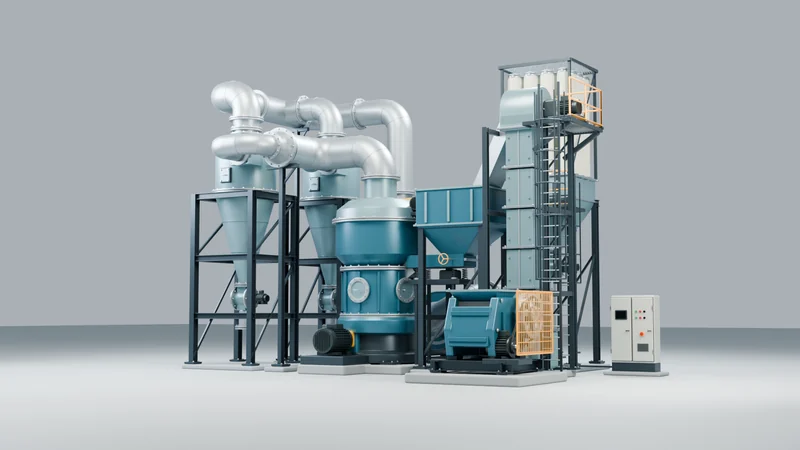
This diagram locates interfaces to assess. Treatment stages are chosen for the material and product; each installation needs its own route.
Quarry material
Characteristics, variations and delivery conditions at the processing plant.
Feeding
Storage, reclaiming and consistent supply to equipment.
Crushing and classification
Size reduction, target fractions and possible return flows.
Suitable processing
Operations needed to meet the product criteria.
Transfer and storage
Product handling and interfaces with packaging.
Bagging
Feeding, weighing, closing and preparation for dispatch.
Start with the material and the saleable product
Describe the mineral, available analyses, block or particle sizes, moisture and expected supply variations. Identify information still unknown instead of substituting a generic value. Equipment selection may require suitable sampling or trials to obtain the missing data; record what those checks are intended to establish.
Define the final product: aggregate, a graded fraction, powder or another product specified by its user. Which criteria apply to particle size, composition, moisture and packaging? For an existing plant, identify what limits the output today. This dossier describes the interface with quarry material; it does not replace a study of quarry extraction operations.
Assess feeding, storage and crushing
Follow material to the first machine: arrival, storage, reclaiming and feeding. Describe the expected maximum size and consistency of supply. Allow space on drawings for handling, cleaning and maintenance. Crushing proposals need to be discussed within these operating conditions rather than assessed only by the main equipment description.
Ask suppliers which material characteristics support their selection and which results will be checked. Identify transfers between machines, intermediate storage requirements and supply responsibilities. Receiving and upstream preparation need consideration even when the order covers just one machine; the equipment still has to connect to the rest of the site.
Connect size fractions and return flows
Screening and classification divide material according to the required characteristics. Define useful fractions and ask how they will be checked. Draw the outputs, material returning for further size reduction and its return points; these flows also need to appear in the diagram used for process sizing.
Confirm the assessed conditions with the supplier: throughput, size distribution, moisture and feed presentation. When several machines connect, use consistent assumptions at their interfaces. A capacity stated for a different incoming stream does not establish that the complete chain will meet your requirements.
Include the treatment your product needs
Fine grinding, micronisation, washing, separation or dewatering should be assessed when justified by the material and target product. Minerals do not all follow the same route. For each proposed operation, ask which criterion it achieves and which conditions are needed at both its inlet and outlet.
AMMARIX's micronisation study illustrates work on grinding requirements and ancillary systems. It does not, by itself, describe every mineral processing installation. Your project needs to connect size reduction with the rest of the chain, including wear, filtration where needed, checks and maintenance access.
Prepare transfers, storage and bagging
Describe how product reaches storage and packaging: transfers, drop points, extraction and supply to the bagging machine. Powders and granular materials do not necessarily handle in the same way. Ask for flow behaviour, dust collection needs and product changeovers to be assessed at the relevant interfaces.
Specify the bag or bulk bag format, intended weight, weighing criteria and operations through to dispatch. Ask what the quotation covers: feeding, weighing, closing, handling or palletising. Connect packaging rate to available product and the team's working arrangements, rather than relying on an isolated catalogue figure.
Consult with shared diagrams and responsibilities
Collect the process diagram, material data, product criteria and available layout. For a project in Algeria, include actual site resources, logistical constraints and spare parts needs. Each supplier should confirm its scope, interfaces, exclusions and expected documentation so the proposals can be assessed together.
Prepare trials with agreed conditions: identified material, equipment configuration, measurement points and acceptance criteria. Assign an owner to each connection and open point. AMMARIX can support requirements definition, machinery comparison and technical coordination so decisions are clear and their resolution can be tracked.
Interfaces to clarify in quotations
Ask for the data shared between stages and the party responsible for each connection.
| Interface | Information to share | Point to confirm |
|---|---|---|
| Quarry → feeding | Material, sizes and variations | Accepted conditions and reclaiming method |
| Crushing → classification | Flows, fractions and returns | Common sizing assumptions |
| Processing → storage | Product, moisture and quality | Required transfers and checks |
| Storage → bagging | Flow behaviour, bag format and weight | Feeding, weighing and included equipment |
| Installation → operation | Drawings, trials and maintenance | Documents, parts and open points |
Prepare your complete-chain dossier
- Mineral description and available analyses or trial results.
- Target product, particle size and packaging.
- Flow diagram showing outputs and return flows.
- Layout, existing equipment and site resources.
- Quotations and interfaces whose responsibilities need clarification.