Resources · Waste treatment and recovery
How to prepare a waste treatment and recovery project.
Start with the waste you actually have and the intended destinations for recovered materials. Before choosing a line, establish the incoming streams, site conditions and suppliers' responsibilities. This guide helps you prepare a new installation, an expansion or an improvement, including projects in Algeria.
From available waste to a defined project
These steps organise project preparation; they are not a treatment recipe for every type of waste.
Describe
Origins, materials, physical form and delivery variations.
Define
Target outputs, acceptance criteria and destinations for rejects.
Check
Representative batches, site constraints and points needing trials.
Compare
The same feed, objectives and scope for every quotation.
Coordinate
Interfaces, trials, documents and handover to the operating team.
Define what arrives and what must leave
A waste treatment objective is not enough information for a supplier enquiry. Identify its origins: industrial activity, collection, retail or another stream. Describe material families, their physical form, observed mixtures and delivery patterns. Separate regular streams from occasional deliveries; an annual average can hide very different working days.
Then define the intended outputs: sorted fractions, material prepared for a recycler or a product for a specific use. Who will accept them, in which packaging and against which criteria? Include rejects and treatment residues. A project needs to extend to the destination of every output, beyond the main machine.
Observe several batches before fixing the solution
Prepare a material dossier with dated photos, available weights, composition changes and problems already observed. If sampling is needed, agree on a method suited to the stream's variability with the people assessing it. A small sample selected for its cleanliness does not necessarily represent an entire delivery.
Ask which information the supplier needs to propose a solution and which assumptions still require verification. Analysis, a site visit or a trial may be needed before some equipment decisions. Retain the batch reference and link conclusions to observed conditions, so you can assess new material without losing the reasoning behind earlier choices.
Plan reception and movements around the site
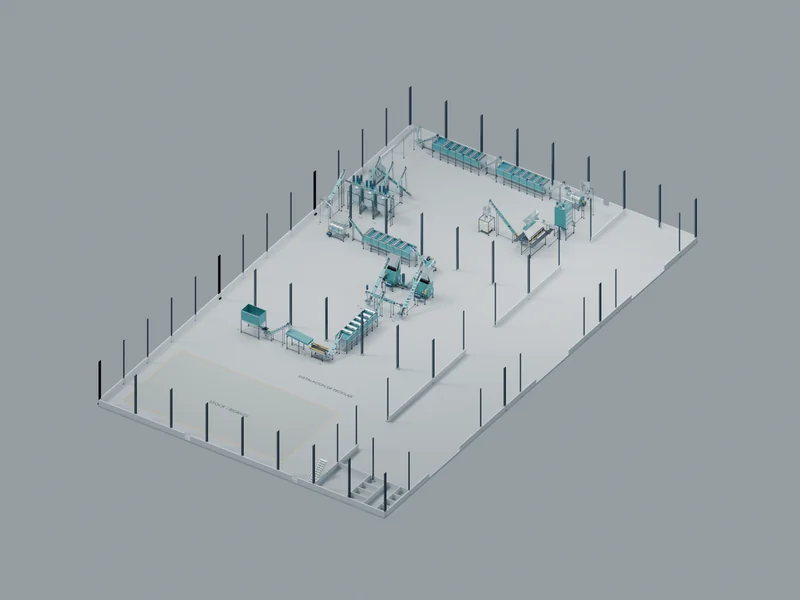
Draw the routes from vehicle arrival to dispatch. Locate incoming checks, storage, equipment feeding and space for separated fractions. Review access and circulation with site operators; the layout needs to remain usable during material handling and maintenance, not only when every machine is running normally.
For an installation in Algeria, describe the resources actually available: electrical supply, water where used by the process, road access and handling equipment. Identify containment, dust collection or water management needs according to the materials. Give each interface a clearly assigned owner within the project.
Connect process choices to the intended outlet
Sorting, separation, size reduction and preparation can serve different objectives. Do not request every operation by default. For each proposed stage, ask which material characteristic it changes and why that change is needed by the next machine or by the buyer of the finished material.
Prepare a flow diagram showing inputs, useful outputs and rejects. When a capacity is quoted, ask which feed and output it describes. Consider cleaning stops, batch changes and residue removal as well. An individual machine's capacity does not, on its own, describe the availability of the whole installation.
Compare quotations beyond the headline price
Give every supplier the same enquiry dossier. Ask them to identify included equipment, conveyors, ancillary systems, connections, installation and trials. Record exclusions in a shared comparison table: they may mean additional work, purchases and interfaces still needing coordination.
Ask about consumables, wear parts, maintenance access and supplied documentation. For a project between Spain and Algeria, clarify transport responsibilities, spare parts availability and support arrangements too. Compare equivalent scopes before comparing totals; keep written answers alongside the quotation revision to which they apply.
Prepare acceptance trials and handover
Before ordering, define what needs to be checked at acceptance: operation with identified material, output characteristics and agreed measurement conditions. Establish who supplies the batches, who records the results and how open points will be resolved. Operators and suppliers should understand the same acceptance criteria.
Collect the process diagram, current drawings, instructions and equipment list. Involve operating and maintenance staff in decisions that affect their work. This gives you a dossier for today's investment decision and for tracking future feed changes or modifications to the installation.
Five questions for a useful supplier enquiry
Complete this table with your data and request a specific answer for each point.
| Topic | Define within the project | Ask the supplier |
|---|---|---|
| Incoming stream | Origin, composition and variations | Accepted materials and assessed limits |
| Outputs | Outlet, quality and packaging | Verifiable criteria and trial method |
| Layout | Access, storage and site resources | Space and required interfaces |
| Scope | Work and equipment already available | Inclusions, exclusions and responsibilities |
| Operation | Organisation, maintenance and batch changes | Parts, documents and support conditions |
What to collect for an initial discussion
- A description of incoming streams and photos from different batches.
- Recovery objectives and intended material outlets.
- A site drawing or sketch showing existing equipment.
- Known constraints and quotations received, if available.
- The decision you need to make: create, expand or improve an installation.